Tying a few flies during the weekend keeps the doctor away! 💊💉
The original Adams created in 1922 by Len Halladay for his friend Charles F. Adams had spent wings and sparse golden pheasant tippet tails. And it originated in Mayfield, Michigan. Nowadays the Adams has been 'Catskilled' and has upright wings and spade hackle tails.
Lady Benson, pink seal’s fur body rather than the usual pink floss
This year marks the 30 year anniversary of the movie based on Norman MacLean's novella 'A River Runs Through It'. This movie (released in October 1992) was responsible for an unprecedented surge of popularity of fly fishing in the USA. Fly shops had unheard record sales as result of the movie and rivers were suddenly crowded as never seen before.
Directed by Robert Redford, an impressive number of people from the fly fishing industry were flown in to help with all the fly fishing scenes in the movie, which is remarkable as just a fraction of the whole movie involves around a fly fishing setting. Within the fly fishing community this movie is simply known as 'The movie'.
As much as this movie having this huge impact in America, outside the USA I doubt it had much impact, if at all. Back in the winter of 1992, a few months after my first trip to Montana that summer, I watched the movie with a few friends in the cinema in Rotterdam. I remember sitting in an almost empty cinema, maybe there were 7 seats taken.
So, did this movie have much impact in your country (outside the USA)?
I decided cut this part from the previous post to make a separate post about the vertical casting stroke, as it really is what every fly fisher(wo)man should learn as the foundation cast. This cast, certainly for trout fishing, could as well be useful for 80% (80/20 rule) of all situations.
The last couple of years it dawned on me how fly casting is pictured as difficult to learn. In spite of all the books, articles on the internet and especially videos on Youtube about fly casting.
Maybe instructors just want to make it look like rocket science? My guess is that most instructors just don't know what the foundation cast is!
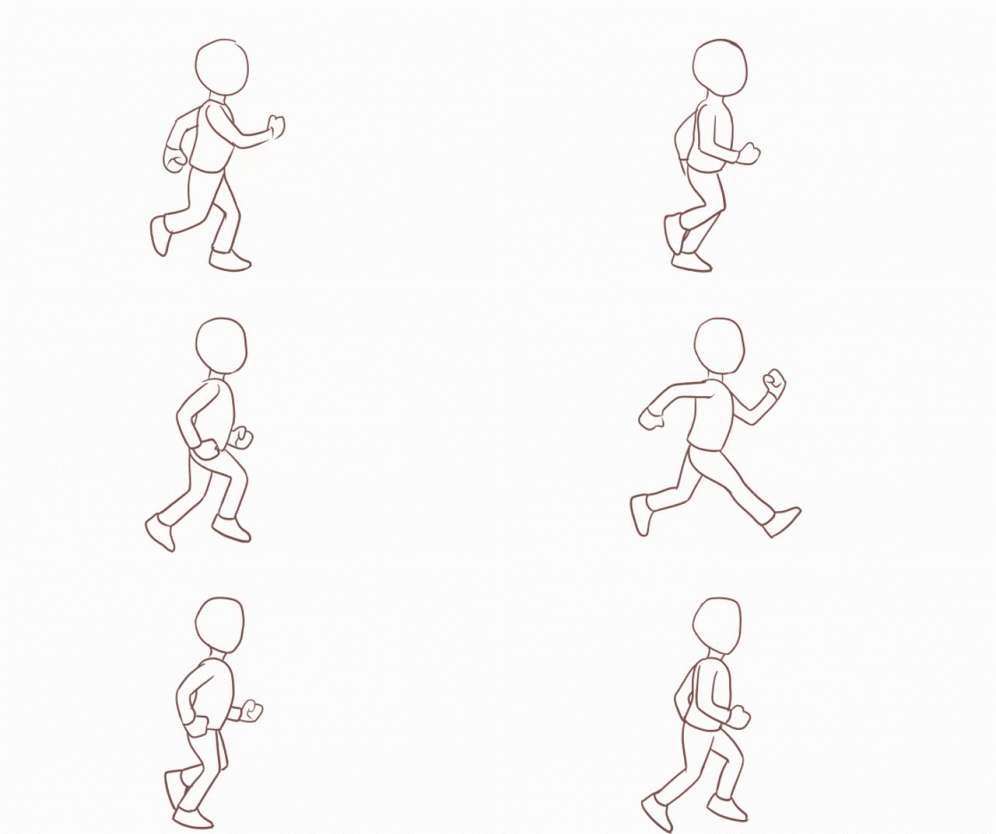
The foundation cast, the vertical casting stroke, is actually very easy to learn. Just pretend you're running: move your arms back and forth while holding the lower arm at an angle (= not straight).
One small adjustment: rotate your movement a bit upwards so the elbow at the 'back swing' ends around your hip rather than past as you can see in the animation on the right. Notice your elbow is going up and down, this is the key to understand the vertical casting stroke (aka San Fransisco Golden Gate casting club style)!
Casting with a fixed pivot
Very often I see casting where the movement is fixed at a 'pivot' (or joint).
This is commonly either the wrist (especially with beginners) or the elbow with the lower arm moving back and forth like a wind shield (or a metronome). Or even worse, side arm casting with the lower arm moving 'outside' (away from the body).
If the casting movement consists of movement only at one pivoting point (joint), this will result in a casting stroke with the tip of the rod that follows an arc (visualise the wind shield of a car screen). The fly line will follow the tip of the rod and the loop will be (very) wide.
The result will be the same what ever the angle a caster is holding his/her rod. Casting in an arc, or 'wind shielding', will result in loops that will either get wider or even turn into an inefficient 'S-loop' if you also rotate with your body (see video below).
The vertical casting stroke
The vertical casting stroke involves the shoulder (the strongest arm muscle!) to pivot, similar to how you move your arms when you run, while the elbow and lower arm act as a 'steering wheel' (by changing the angle of the lower arm). Short distance casting, the angle of the lower arm is very narrow. Longer casts the angle widens a bit more. The wrist (no more than a hair's movement!) gives the final acceleration at the end of both the back and forward cast.
The vertical casting stroke is surprisingly easy to master even to a level of looking effortless, because casting should be effortless!
Here is a student of John Juracek showing the basic vertical casting stroke. Notice the elbow moving up and down in the same vertical plane (and not moving away from the body as in the side arm cast). The difference from the 'running arm movement' is that the 'back' swing of your elbow (end of the forward cast) stops around the lowest point (just above your hip). By the way, don't forget to adjust the angle of the casting stroke as well as the trajectory depending on the distance you're casting!
Here's one of the many casting 'instruction' videos on Youtube. This guy is showing his casting as so many casting instructions show as being the basic casting stroke: side arm casting and here even with the upper arm raised up which puts a lot of stress on the shoulder. Notice on his back cast he is also rotating with his body resulting in an inefficient S-loop: look at the loop of the fly line the moment he starts to rotate his body.
First of all this casting 'style' which I see so often is very tiring (do this the whole day and you'll end up with a very sore shoulder). In fact some people seem to even get casting injuries! Using this casting style is also very difficult to get consistency in the casting stroke. Try this with your non casting arm and you'll notice how difficult it is to get your back and forward cast move & look the same (= rod tip traveling in one plane, at any angle for that matter).
With the vertical casting stroke it's quite easy to cast a nice tight loop traveling at a vertical plane with the non dominant arm in a matter of a few minutes!
To be honest I have been reluctant to make 'another casting instruction' video. There are so many 'instruction videos' on the internet already (and more coming every week) with questionable quality.
Set in the settings button (next to the volume button) the video quality to at least 1080 or higher and play back speed to 75% or 50% for the best view of the casting movements.
Update 1 Juli 2024:
Listen to this podcast with Maxine McCormick. The youngest fly casting world champion. Here she explains how the basic casting movement works. There are many tips by Maxine, around 37:00 Maxine talks about what she calls the up & down movement where the shoulder rotates, much like the running movement.
Update 30 Dec 2022:
*** The video is disabled by the owner of the video (School of Trout) but you can still view it by clicking here ***
Sometimes side arm casting is preferred like casting with weighted or wind resistant flies to keep the fly as far away to prevent from getting hit. However for most trout fishing situations casting a vertical casting stroke is the way to go.
Why? It’s much more accurate. Simply your hand tracks in the line of your eye sight. Why do you think bow shooting is done with the arrow in the line of the eye sight? And it takes less ‘casting room’ (illustration by Joe Mahler).
Problem with side arm casting
The most common problem with side arm casting is that the body turns a bit while moving the arm back during the back cast. This causes the casting plane to curve resulting in an inefficient 'S-loop'. A good way to prevent the body turning is putting the same foot as your casting arm forward with your stance.
Horizontal casting
As mentioned earlier the horizontal cast, the rod held more or less horizontal parallel to the water, is not what is meant with the side arm cast. The horizontal cast is useful for certain conditions like casting under a branch or get a fly to kick over to get a curved delivery cast.
To finish off the weekend a fly with body made of a mix of fox fur and tobacco color dyed seal's fur. The badger hackle with the dark center gives the fly a nice contrast.
It was already almost a year ago the DAAFT, a re-grouped bunch of tiers with many with the original DAAFT history, to enjoy a day of tying together.
A few pictures of the flies from a frame with flies from the former American members of the original DAAFT, including a nice deer hair mouse from my late friend Chris Helm.
As 'small' a country South Africa is in fly fishing, and there aren't many fly fishers around in South Africa I've been told, there are some seriously stuff coming from that country. Fly fishing authors like Tom Sutcliffe, Ed Herbst, Peter Briggs and recently Gordon van der Spuy. But also bamboo rod maker Stephen Boshoff.
Here's video where my friend Gordon van der Spuy ties a parachute version of the typical South African dry fly the Rab, which has its link to the skaters and variants from the times of Edward Hewitt.
I have been looking for the right shiny blue material to use for the Blue bottle Humpy. I looked at dubbing (like ice dubbing alike) and thread/tinsel. None of the ones I saw had the bright sheen, durable and the right price. Then I found this streamer wing material that is incredibly tough, has the right sheen and there's so much in a pack that I'll never run out of it.
Recently I've been using it for other styles of flies. One is a variation on the Pink Lady, I named Blue Esquire, but now with the shiny blue body. I have no idea if fish might like it but I like the looks of it.
A winged spider fly with some inspiration by the Devils Crook.
Spiders can be very simple and effective, but they can be a bit boring to look at. Adding a pair of mallard wing (stubs) just behind the soft hackle does make it a lot more appealing. The smooth body of raffia, a tuff of fox dubbing in the thorax and this fly has the looks of an emerging caddis.
Catskill Fly Fishing Center and Museum: ‟The Woman Fly Fishers Club commissioned Ed Van Put to come up with a commemorative fly for their 90’th anniversary, and he did with the Joan Wulff Special”. Ed also came up with the Able Mable for the club's 60'th anniversary back in 1992.
“The Abbey. In America, the Abbey is credited to, and named after Mr. Charles Abbey, of Abbey & Imbrie, a New York firm of fishing – tackle dealers. The fly has been popular in this country many years. It is claimed that it is an English pattern of old standing, which received its name from a building,not from an individual ; also that long before it was called the Abbey fly it was in general use, known as the Jew fly.” (Mary Orvis Marbury in Favourite flies and their histories, 1892)